 blog
How to Spot 5 Signs of Vision Problems in Kids
Last Updated: November 2, 2026
Quick Summary
Vision problems in school-aged children often show up as squinting or sitting too close to screens and books, frequent headaches or eye rubbing, reading trouble, head tilting or covering one eye, and trouble seeing the board. Many kids do not complain, so parents and teachers should watch for these patterns.
- Squinting or sitting very close to screens and books is one of the most common signs.
- Frequent headaches or eye rubbing after reading or screen time can point to eye strain.
- Losing place, skipping lines, or avoiding near work may signal a vision issue.
- Head tilting or covering one eye can indicate an alignment or focusing problem.
- Track behavior for one to two weeks and bring notes to a comprehensive eye exam.
Table of Contents
- Why Vision Problems in School-Aged Children Often Go Unnoticed
- Sign 1: Squinting or Sitting Too Close to Screens and Books
- Sign 2: Frequent Headaches, Eye Rubbing, or Watery Eyes
- Sign 3: Reading Difficulties, Losing Place, or Avoiding Near Work
- Sign 4: Head Tilting, Covering One Eye, or Unusual Posture
- Sign 5: Classroom Clues Like Trouble Seeing the Board or Poor Coordination
- Age-Specific Differences and When Symptoms Are Urgent
- Booking Your Child's Comprehensive Eye Exam at See Clearly Florida
- Frequently Asked Questions
Why Vision Problems in School-Aged Children Often Go Unnoticed
Vision problems affect many school-aged children, yet they are one of the most overlooked health issues in childhood. Most kids do not complain about blurry vision because they assume everyone sees the same way they do. Families often have no idea their child is struggling until a teacher or parent notices a pattern.
Many children simply adapt. They sit closer to the board, squint at homework, or avoid reading altogether. These habits can look like normal kid behavior, which is why they often slip past parents and teachers.
A vision problem is any issue that stops the eyes and brain from working together clearly and comfortably. Common examples include nearsightedness, farsightedness, astigmatism, and eye teaming or focusing problems. American Academy of Ophthalmology pediatric eye health guidance
Watch for these five signs. Each one can point to a vision issue worth checking.
- Squinting or sitting too close to screens and books
- Frequent headaches, eye rubbing, or watery eyes
- Reading trouble or avoiding near work
- Head tilting or covering one eye
- Classroom clues like trouble seeing the board
Sign 1: Squinting or Sitting Too Close to Screens and Books
Squinting is one of the most common signs a child may need glasses. Kids often squint to sharpen blurry images, whether they are reading a book or watching the television.
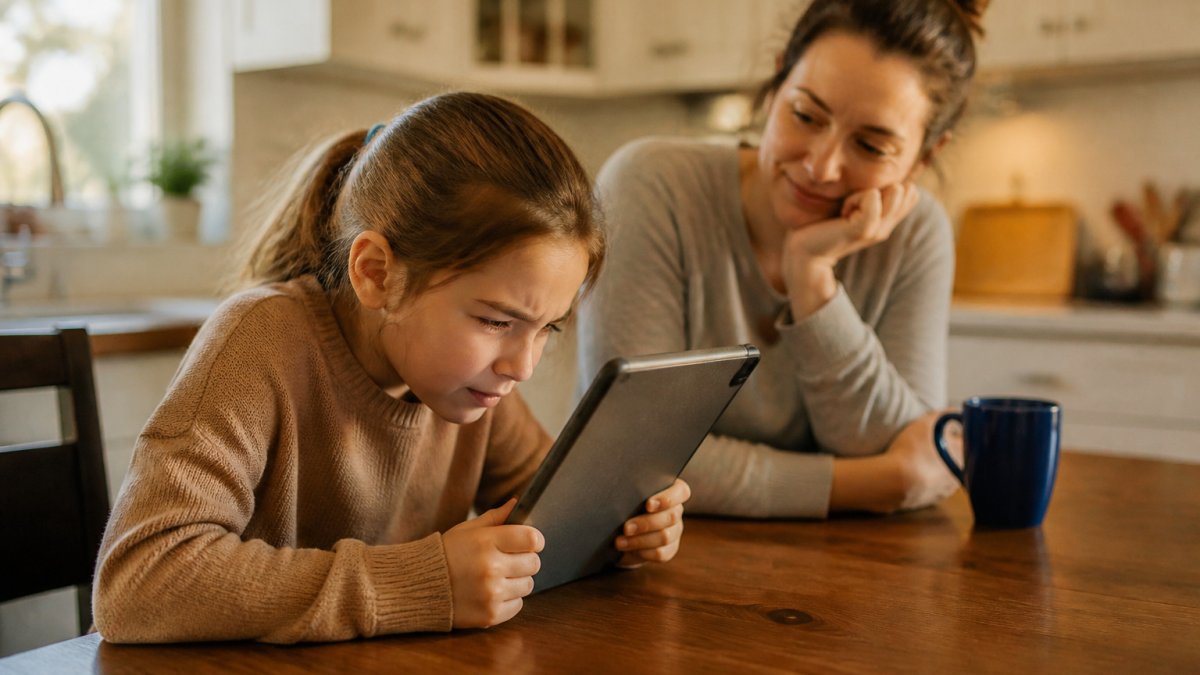
Sitting very close to screens is another frequent clue. A child may lean toward a tablet or sit right up against the TV because objects look clearer at close range. This habit often shows up with nearsightedness, where distant objects look fuzzy. Parents wondering whether myopia control is worth considering can read our guide to what it involves.
Here is what to watch for:
- Squinting when looking at the whiteboard or distant signs
- Holding books or devices unusually close
- Sitting near the front of the room or in front of the television
- Tilting the head to see better
Many parents assume a child who sits close is just being playful. Pay attention if the habit is new or happens every day.
Sign 2: Frequent Headaches, Eye Rubbing, or Watery Eyes
Headaches in kids can have many causes, but frequent headaches after reading or screen time may point to eye strain. Children with uncorrected vision often work harder to see, which tires the eyes and brain.
Eye rubbing and blinking more than usual are also common. So are watery or red eyes, especially after close work. These signs deserve a closer look when they keep coming back.
Possible signs include:
- Headaches that show up during or after homework
- Rubbing eyes often, especially when tired
- Watery, itchy, or red eyes during reading
- Complaints of burning or tired eyes at the end of the day
Sign 3: Reading Difficulties, Losing Place, or Avoiding Near Work
Reading takes a lot of visual skill. The eyes must focus, track across the line, and jump smoothly to the next line. If any part of that process is hard, reading can feel exhausting.
A child with a vision issue might lose their place often, skip words, or read very slowly. Some kids avoid reading, coloring, or puzzles entirely because these tasks feel uncomfortable.
Be aware of these patterns:
- Losing place or skipping lines while reading
- Avoiding books, drawing, or games that need close focus
- Slow reading speed compared to classmates
- Reading with a finger or ruler to keep their place
Reading problems can also come from other causes, such as learning differences. A vision check helps rule out one possible factor.
Sign 4: Head Tilting, Covering One Eye, or Unusual Posture
Some children develop unusual head positions to help their eyes work together. Tilting the head, turning it to one side, or covering one eye with a hand are all possible signs of an eye alignment or focusing issue.
Kids may do this without realizing it. A child might cover one eye to stop double vision or to see more clearly. Parents often notice this when a child poses for photos or watches a screen.
Look for:
- Tilting or turning the head when looking at objects or people
- Closing or covering one eye during tasks
- Leaning the body to get a better view
- Crossing or drifting eyes at times
Sign 5: Classroom Clues Like Trouble Seeing the Board or Poor Coordination
School is often where vision problems surface first, because classroom tasks demand sustained distance viewing, near viewing, and quick shifts between the two. A teacher may notice that a child copies from the board slowly, leaves gaps in copied notes, sits too close to the front, or squints at the projector. The useful question is not only whether a child shows these clues, but when, where, and how often they appear.
Poor hand-eye coordination can be another clue. A child who struggles to catch a ball, color within the lines, cut neatly with scissors, or judge distance on the playground may have trouble with visual tracking or depth perception. These tasks require the eyes to aim, follow, and team together, and difficulty with them can overlap with refractive errors, eye teaming problems, or focusing issues.
A child with these signs is not automatically struggling with vision. Attention, learning, language, and emotional factors can produce similar classroom behavior, and vision problems do not explain every learning or attention difficulty. The goal is to rule vision in or out with a professional exam, not to assume it is the cause.
- Squints, leans forward, or moves closer when looking at the board, projector, or TV
- Holds books or devices closer than arm's length, or pushes them away
- Loses place, skips lines, or uses a finger or ruler to track text
- Tilts or turns the head, or covers one eye during reading, screens, or photos
- Complains of headaches, tired eyes, or blurry vision after homework or screen time
- Rubs eyes, blinks excessively, or has watery eyes during near work
- Avoids reading, drawing, puzzles, or board-copying tasks
- Copies from the board slowly, with omissions or errors
- Struggles with ball games, catching, coloring within lines, or cutting
- Appears inattentive or fatigued specifically during visual tasks
Note whether the behavior is new, happens daily, or appears only at certain distances or times of day. That pattern is more useful to an eye doctor than a single observation.
The article lists a few classroom and playground clues that can point to a vision problem, and what each one may signal.
| Clue | Where it shows up | Possible vision link |
|---|---|---|
| Copies from the board slowly | Classroom | Distance viewing difficulty |
| Leaves gaps in copied notes | Classroom | Tracking or focusing issue |
| Squints at the projector | Classroom | Refractive error |
| Struggles to catch a ball | Playground | Visual tracking or depth perception |
| Trouble coloring within lines | Classroom | Hand-eye coordination |
| Trouble cutting neatly with scissors | Classroom | Hand-eye coordination |
Age-Specific Differences and When Symptoms Are Urgent
Symptoms can look different at each age, and the same behavior can mean different things depending on a child's stage. Younger children, especially those in early elementary school, often cannot describe what they see. They may not say "blurry" because they assume everyone sees the same way. Instead, parents and teachers see behavior: sitting very close to a screen, holding a book near the face, rubbing eyes during coloring, or avoiding puzzles and drawing.
Older school-aged children can often explain blurry vision, headaches, or tired eyes, but they may hide problems to avoid standing out, missing recess, or wearing glasses. Watch for a child who suddenly avoids the board, copies notes from a classmate, or complains of headaches only on school days.
Children who cannot clearly describe what they see, including those with developmental delays, speech differences, or attention challenges, depend on adult observation. For these children, the checklist above matters more than any verbal complaint.
Most children should have their first comprehensive eye exam before starting school, and regular checkups are recommended as they grow. American Optometric Association children's vision guidance
Some symptoms need prompt attention rather than a routine appointment. Contact an eye care professional quickly if your child has:
- Sudden loss of vision in one or both eyes
- Eye pain, redness with light sensitivity, or discharge
- Double vision that appears suddenly
- An eye injury or a change in how one eye looks
- A new or worsening headache with vision changes
A comprehensive eye exam checks more than the ability to read letters on a chart. It tests focusing, eye teaming, eye health, and how well both eyes work together. A comprehensive exam goes beyond the basic checks used in many school vision screenings. Screenings can miss focusing or eye teaming issues that still affect reading and classroom comfort.
Different causes can produce similar behaviors. Squinting may come from nearsightedness, astigmatism, or eye teaming issues. A thorough exam is the only way to know which one is involved, and it helps parents avoid guessing based on a single sign.
Booking Your Child's Comprehensive Eye Exam at See Clearly Florida
If you notice one or more of these signs, schedule a comprehensive eye exam. At See Clearly Florida, our optometrists take time to understand your child's visual needs and daily routine before making any recommendations.
Our practice works with flexible vision plan benefits, and we are not limited to specific insurance networks. We can also submit insurance claims on your behalf. You can book an eye exam for your child to meet the optometrists before your visit.
If cost is a concern, our team can review options with you. Our pediatric eye exam cost guide explains what an exam typically costs without insurance. For current pricing, visit the See Clearly Florida website or request a quote before you schedule.
Your child should not have to struggle to see clearly. Schedule a visit at See Clearly Florida to learn more about your child's vision health.
Frequently Asked Questions
What are the signs of vision problems in school-aged children?
Common signs include squinting, sitting very close to screens or holding books near the face, frequent headaches or eye strain, rubbing or watering eyes, and losing place while reading. Some children also tilt their head or cover one eye. Any of these patterns is a reason to schedule an eye exam, even if the child has never complained about vision.
How can I tell if my child needs glasses?
Watch for squinting at distant objects like the whiteboard, holding reading material very close, or avoiding close work such as coloring or puzzles. A school vision screening can flag possible problems, but it is not a full eye exam. Only a comprehensive eye exam with an eye doctor can determine whether glasses are needed and what prescription, if any, is appropriate.
How often should school-aged children have an eye exam?
Children should have a comprehensive eye exam before starting school and then at regular intervals guided by their eye doctor, especially if they show any of the warning signs or have a family history of eye problems. Ask your eye doctor for a recommended schedule based on your child's age and needs, and book sooner if symptoms appear between visits.
Can vision problems affect a child's school performance?
Yes, uncorrected vision problems can make it harder for a child to see the board, read comfortably, or keep up with near-point work, which may affect classroom participation. However, vision is only one possible factor in learning difficulties. A comprehensive eye exam can rule vision in or out, so the child's teacher and pediatrician can then look at other causes if needed.