 blog
blog
Best Eye Exam for Dry Eyes: A 2026 Guide
Table of Contents
- What a Dry Eye Exam Evaluates
- Key Dry Eye Testing Methods
- How Eye Doctors Diagnose Dry Eye Disease
- Choosing the Right Dry Eye Doctor
- Symptoms That Warrant an Early Evaluation
- Dry Eye Treatment Options After Diagnosis
- What to Expect During Your Appointment
- Frequently Asked Questions
Last Updated: October 9, 2026
What a Dry Eye Exam Evaluates
A dry eye exam goes far deeper than a standard vision check, focusing on your tear film, ocular surface, and tear-producing structures to identify why your eyes feel uncomfortable and build a treatment plan that works. (Source: prevalence of dry eye disease)
Your eye doctor assesses tear production and quality, checks your eyelids and meibomian glands, inspects your cornea and ocular surface, and reviews your medical history, lifestyle, and medications, since these often trigger dry eye disease.
A standard eye exam tells you if you can see clearly; a dry eye exam tells you why your eyes hurt and what to do about it. We prioritize this approach because dry eye is often overlooked in routine visits.
Key Dry Eye Testing Methods
No single test diagnoses dry eye disease. Your eye doctor runs a battery of tests measuring tear fluid volume, stability, ocular surface health, and meibomian gland function. Knowing what each test does makes your results and treatment plan easier to follow.
Here is how the common tests compare side by side.
Schirmer's Test and Tear Production
What it measures: The volume of tears your lacrimal glands produce over a fixed period.
Comfort and time: Mildly irritating at most, mainly from the paper edge. The test itself takes about five minutes, plus setup.
How results are read: Wetting under 5 millimeters in five minutes suggests reduced tear production; above roughly 10 millimeters is normal.
What it cannot establish: Schirmer's measures quantity only. A normal result does not rule out dry eye, since many people make plenty of tears that evaporate too quickly.
A related option, the phenol red thread test, uses a fine thread instead of paper.
Tear Breakup Time (TBUT) and Tear Quality
What it measures: How long your tear film stays intact on the eye surface before a dry spot appears.
How it is performed: Your doctor instills fluorescein dye, asks you to blink, then times through a slit lamp how long until the first dry spot forms.
Comfort and time: The dye may briefly sting or blur vision. The measurement takes seconds, though the full sequence with setup is a few minutes.
How results are read: A breakup time of 15 seconds or longer is typically normal.
What it cannot establish: TBUT shows the tear film is unstable but not always why.
Slit Lamp and Ocular Surface Examination
What it measures: The health of your cornea, conjunctiva, eyelids, and tear film under magnification.
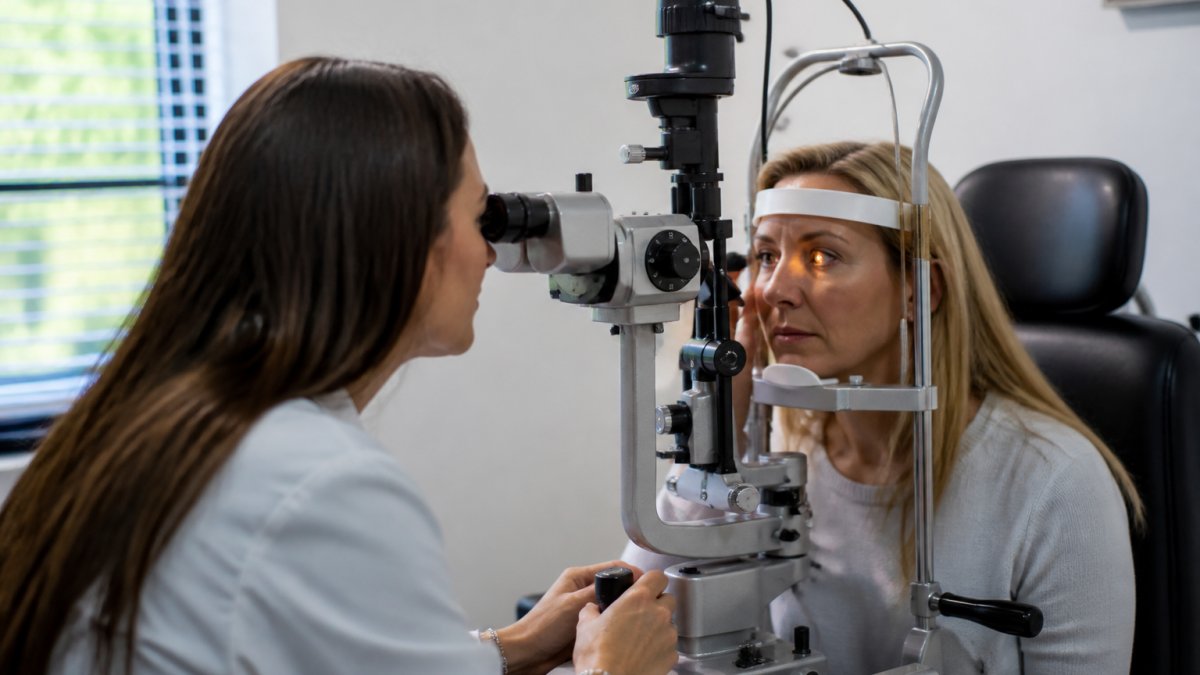
How it is performed: You rest your chin and forehead on a support while your doctor shines a narrow beam of light through a microscope and scans your eye. Dyes may highlight damage.
Comfort and time: Painless. The exam takes a few minutes.
What it cannot establish: A slit lamp exam shows existing damage, not the underlying cause.
Meibomian Gland Evaluation
What it measures: Whether the oil-producing glands in your eyelids are blocked, atrophied, or expressing normally.
How it is performed: Your doctor applies gentle pressure along the eyelid margin and watches how the oil (meibum) comes out. Imaging devices may map the glands directly.
Comfort and time: Pressure on the lid can feel odd but is usually not painful. It takes a few minutes.
How results are read: Clear, flowing oil suggests healthy glands. Thick, cloudy, or absent oil suggests meibomian gland dysfunction, a leading cause of evaporative dry eye.
Interpreting Results and Test Limitations
Dry eye is diagnosed from the whole picture, not a single number. Your doctor weighs symptom history, medications, and lifestyle against objective findings.
No single test identifies every cause or grades severity perfectly. Schirmer's can miss evaporative dry eye, TBUT can be thrown off by dye or blinking, and slit lamp findings show damage but not its source.
If a provider diagnoses based on symptoms alone or one test, ask what else can be checked. A complete picture usually requires a tear-production measure, a tear-stability measure, and a gland and surface exam.
How Eye Doctors Diagnose Dry Eye Disease
Your eye doctor combines multiple test results to diagnose dry eye disease and gauge severity, since dry eye has many causes. Some people have aqueous-deficient dry eye, where lacrimal glands don't produce enough tears.
Your doctor also considers symptoms: gritty, burning, or irritated eyes, vision that blurs by day's end, or excessive watering, which paradoxically signals dry eye because irritation triggers reflex tearing.
Medical history matters too. Antihistamines and antidepressants reduce tear production, autoimmune conditions like Sjögren's syndrome cause dry eye, and hormonal changes such as menopause raise risk.
Choosing the Right Dry Eye Doctor
Not every eye doctor specializes in dry eye disease. Some optometrists and ophthalmologists have advanced training in tear film disorders and ocular surface disease.
Look for doctors who use multiple diagnostic tests rather than symptoms alone. A thorough dry eye evaluation typically takes 30 to 45 minutes; a rushed appointment is a red flag.
Ask whether your doctor manages moderate to severe dry eye. Some practices handle mild cases well but refer complex ones elsewhere.
We focus on personalized dry eye care tailored to your specific situation. Our experienced optometrists deliver personalized, expert care tailored to your unique vision needs.
Symptoms That Warrant an Early Evaluation
Some dry eye symptoms warrant an evaluation sooner rather than later.
Blurry vision that improves with blinking is a classic dry eye sign, as is excessive tearing from irritation-triggered reflex tears. Light sensitivity and difficulty wearing contact lenses are also common complaints.
Some symptoms require urgent attention. Extremely painful eyes, sudden vision changes, or discharge warrant seeing an eye doctor immediately, as these could signal infection or corneal damage rather than simple dry eye.
Don't assume your symptoms are normal or permanent.
Dry Eye Treatment Options After Diagnosis
Your treatment plan depends on what your eye exam reveals about the cause and severity of your dry eye. Mild cases often respond to artificial tears and lifestyle changes like screen breaks and a humidifier.
Your dry eye exam results guide which treatments make sense for you, which is why an accurate diagnosis matters. Treatment works best when it addresses your specific problem.
What to Expect During Your Appointment
A dedicated dry eye evaluation is longer and more structured than a routine vision exam. Knowing what to bring, pause beforehand, and ask makes the visit far more useful.
Before You Go
Contact lenses. Ask how long to leave your lenses out before testing. Many practices ask for 24 hours or more, since lenses change the tear film and can skew Schirmer's and TBUT results.
Eye drops and medications. Ask whether to hold lubricating drops on exam day, since some can mask an unstable tear film.
Time and comfort. Plan for 45 minutes to an hour and arrive 10 to 15 minutes early for intake forms.
Costs, Insurance, and Access
Cost is one of the least-discussed parts of a dry eye workup, and it varies widely by practice, region, and how the visit is coded.
- Routine vs. medical visit. A routine vision exam may fall under a vision plan; a medical evaluation for a diagnosed condition may fall under health insurance instead. Coverage can differ greatly.
- Diagnostic testing. Some tests are bundled into the exam fee; others, particularly meibomian gland imaging or advanced tear-film analysis, may be billed separately and not covered.
- Specialized evaluations. A dedicated dry eye workup at an ocular surface disease practice often costs more than a standard exam because it takes longer and uses more equipment. Ask for an estimate beforehand.
- Questions to ask your insurer or the office. Is this visit covered as medical or vision? Is prior authorization needed? What is my copay or coinsurance? Which tests are included, and which are out of pocket?
Getting these answers in advance avoids surprise bills and helps you decide whether a specialized evaluation is worth the added cost.
Questions to Ask During the Visit
Bring a short list so you don't forget in the chair:
- Which tests are you running, and what is each looking for?
- What did my results show versus normal ranges?
- Is my dry eye from low tear production, fast evaporation, or both?
- Are my meibomian glands blocked or damaged?
- What is the likely cause, and what can I change at home?
- What is the treatment plan, and how long before I notice a difference?
- When should I come back, and what would signal the plan isn't working?
Understanding Your Results
Ask your doctor to walk you through the numbers, not just the conclusion:
- Normal ranges are guides, not cutoffs. A Schirmer's result or TBUT just outside the normal range doesn't automatically mean disease, and one inside doesn't rule it out.
- Symptoms and findings are weighed together. Your reported symptoms carry real weight, especially when results are borderline.
- One test rarely tells the whole story. A single abnormal result points to an area to investigate; it doesn't identify the cause or grade severity by itself.
- Results can change over time. Dry eye fluctuates with seasons, screen time, medications, and hormones, so a recheck may be needed to see how you respond to treatment.
We provide a patient portal where you can access your exam results, prescriptions, and treatment recommendations anytime, so you can review the details after the visit and track how your plan is working.
Frequently Asked Questions
What tests are included in a dry eye exam?
A comprehensive dry eye exam typically includes tear production measurement (Schirmer's test), tear breakup time (TBUT) to assess tear stability, slit lamp examination of the cornea and ocular surface, meibomian gland evaluation, and review of your medical and eye health history. Your eye doctor may also use additional tests like phenol red thread tests or tear osmolarity measurements depending on your symptoms and suspected causes. These tests together help identify whether dry eye is caused by reduced tear production, poor tear quality, or excessive tear evaporation.
Is it better to see an optometrist or ophthalmologist for dry eye?
Both optometrists and ophthalmologists can diagnose and manage dry eye disease. Optometrists perform comprehensive eye exams and can prescribe most dry eye treatments. Ophthalmologists are medical doctors who can handle more complex cases, prescribe medications, and perform specialized procedures. For routine dry eye diagnosis and initial treatment, an experienced optometrist is often sufficient. If your condition is severe or requires specialized procedures, an ophthalmologist may be necessary. Choose based on the complexity of your symptoms and your preference for personalized, flexible care.
When should I see an eye doctor for dry eye symptoms?
Schedule an appointment if you experience persistent burning, irritation, blurry vision, or grittiness that lasts more than a few days. Early evaluation is especially important if symptoms worsen despite using over-the-counter eye drops, if you have a history of dry eye, or if you take medications known to reduce tear production. Don't wait until symptoms severely impact your daily life or vision quality. Many people delay seeking care, but early diagnosis allows your eye doctor to develop a tailored treatment plan and prevent long-term complications.
Can a regular eye exam diagnose dry eye?
A regular comprehensive eye exam can identify signs of dry eye, but a specialized dry eye exam is more thorough. Standard exams may not include specific tear production or tear quality tests. If you suspect dry eye, tell your eye doctor about your symptoms beforehand so they can include targeted testing. A specialized dry eye exam focuses on tear film stability, meibomian gland function, and ocular surface health, providing a more complete diagnosis and allowing your eye care specialist to create a personalized treatment plan tailored to your specific dry eye causes.